Sunday, June 24, 2012

Gimpy

I wish English had a better word than "weakness" to describe the movement on my affected side. If it was just weakness, I would have been done with the recovery process a long time ago. Like many stroke survivors, I have a constellation of problems, in varying degrees: weakness, spasticity, lack of sensation, confusion of sensation, lack of proprioception, neglect, pain, etc.

Every so often, I use the word "hemiparesis." But it means the almost same thing as weakness. And it has too many syllables.

Another fellow stroke survivor and blogger, Lori, uses the word "gimpy." The word is growing on me. I think it has just the right amount of vagueness to describe the general weirdness with my right side.

So here's a video, filmed on 4/29/2012, of me doing one of my daily tasks--putting away utensils--with my gimpy hand:


Monday, June 11, 2012

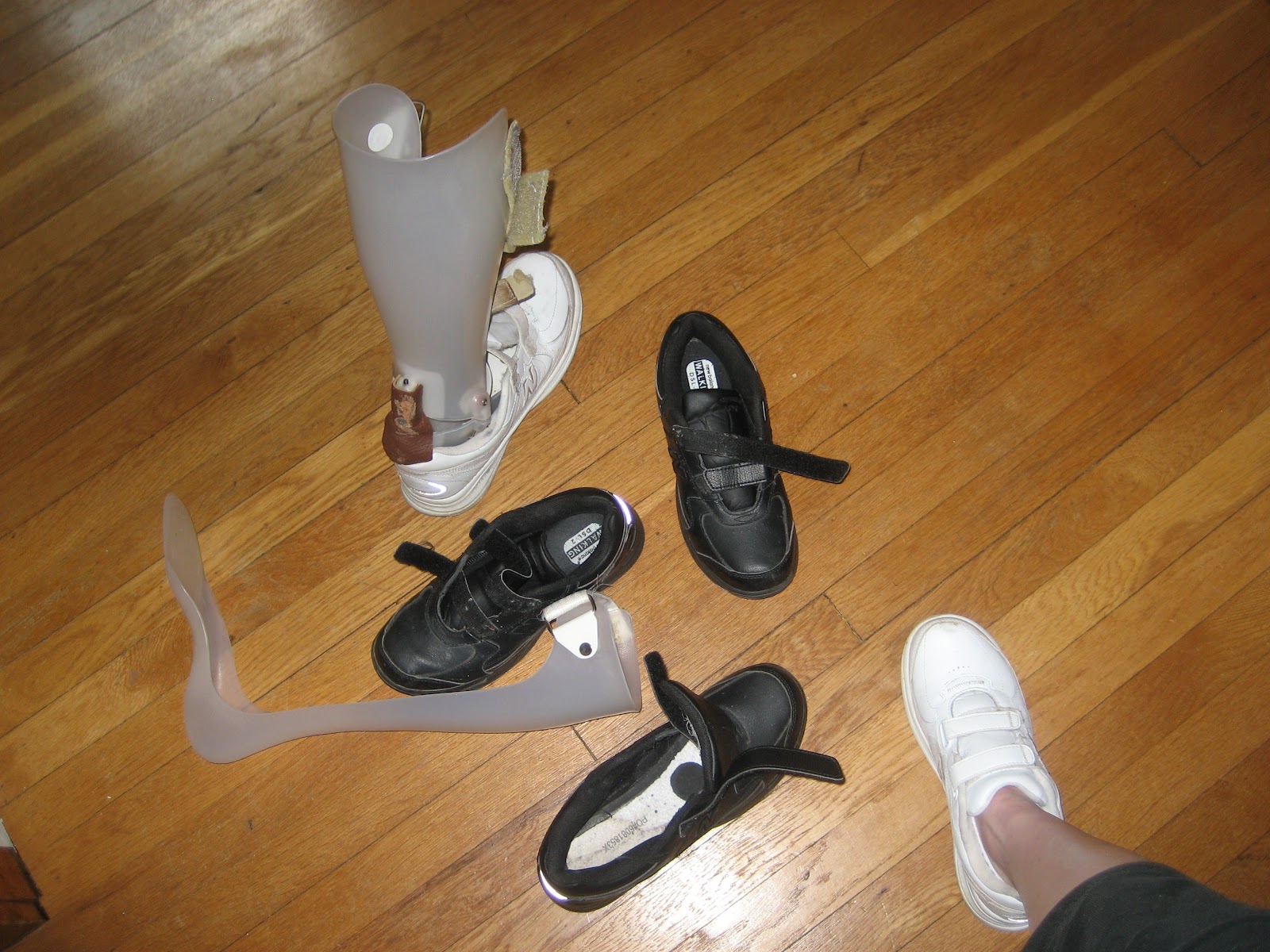
So Long, Brace

I’m done with the brace. For now, at least.

This was my second brace, and my second try of getting off of a brace. So who knows, I might need a third round at some point. 

My gait is still uneven, and I still use a cane. And much to my disappointment (and my daughter's), I'm still wearing the same stupid Velcro sneakers.

For now.


Tuesday, June 5, 2012

Published

I wrote a personal essay for the American Speech and Language Association's newspaper, The Leader. It's my first publication since the stroke.

Here it is:  You Can't Just Wear Socks!

Thank you, Rick and Jena, for your expertise but especially your kindness.

Tuesday, May 15, 2012

Imagination Rehab

The are many things I can't do since the stroke. For instance, I know that riding a bicycle is out of the question. At least for now. My lack of proprioception, sensation, balance issues,  and general right-side weakness are a few of the reasons. And it doesn't help that we live on a very hilly neighborhood. I haven't even had the desire to try.

About two months ago, we were driving on level ground, on a road with a bike lane. There was a bicyclist a few yards ahead of us, and from the car window, I had a great view of the bicyclist pedaling. The traffic was moving slowly. I watched him biking for several minutes. Suddenly, I remembered what it felt like to be on a bicycle: the wind, the noise of cars going by, the pedaling, the gliding, my own breath and the pumping of my heart. I had forgotten.

Sometimes I feel the stroke robbed me--temporarily--of parts of my imagination. Until something jogs my memory, my body can't conceive of some of things I used to do. And how I did them.

But little by little, my imagination is coming back. 

Friday, May 11, 2012

A Very Good Prognosis

My sister knows how devastating the stroke has been, for me and my whole family. She’s been a rock of strength and support. But every so often, when we’ve talked about how hard it’s been, she would also remind me: I’m on the upswing. It’s not like, say, cancer, she would say.

Well, in January I was diagnosed with cancer—sort of. It's a kind of breast cancer called ductal carcinoma in situ (D.C.I.S.), often called stage 0. It’s not one of the kinds of scary cancer my sister was thinking about. There is even some controversy about if it should be even called cancer (I like this NY Times article). D.C.I.S. is almost never life-threatening.

But it’s been a long four months since the diagnosis, and figuring out what to do about it. The fear that comes with the word “cancer” is one thing. The fatigue of entering back to the medical (and bureaucratic) world is a whole different story. It has felt so cruel: finally I had enough energy and fluency to chat with other parents at the playground, but now I needed to put my energy in talking to doctors about treatment options. Also, most of the doctors and medical people have been nice, but they haven’t seen many mid-life stroke survivors. At the appointments, sometimes I wanted to say: do you know how much energy this is costing me? Do I really have to change into the examining gown this time? Because I might have the energy to change into and out of the gown, or make dinner this evening, but probably not both.

Fortunately, this chapter of my saga is closed for now. I had minor surgery, and I can go back to focus on stroke recovery.

The really weird thing is this: I seem to be getting better all the time, despite everything. Maybe the diagnosis forced me to talk and write even more. Maybe my brain fog has been better because I've had to strategize about how to explain my issues before every appointment. Maybe I have even more of a sense of urgency about my stroke recovery.

 Who knows? Or maybe my brain was just ready to get better.

Friday, April 20, 2012

Coffee Therapy

I'm always looking for clues.

I'm always trying to figure out to get my body to move the way it used to move. The way it should move.

For instance, every day my long-suffering husband, Neal, brings my coffee to me in bed. I sit up, turn, and arrange myself so I can sit cross-legged facing the mirror that we (Neal) hung to help me do my exercises. Then I sip my coffee from my coffee canister. To the uninitiated, it looks like, well, I'm just drinking coffee very slowly, mostly with my affected (right) arm.

In fact, I'm hard at work. These days I'm concentrating on my neck muscles. As I use my right hand to bring coffee canister to my lips, I examine my right shoulder and my neck in the mirror. Every time I bring the coffee up with my right, my right neck muscles bulge. On the left, the neck muscles don't move. Aha: my neck muscles shouldn't be "helping." Each inch my right arm travels, I try to adjust my arm just enough that so that my arm and shoulder muscles are doing most of the work, instead of the neck muscles. Then I try to really feel the right shoulder muscles, my back muscles, my arm muscles--the ones that should be doing the bulk of the work.

Then sip more. Then do it again. And again. And again...


(Read Rebecca's excellent blog, Home After a Stroke, for more information about synergistic  movements, which I'm trying to lessen in this phase of my recovery. I'm not sure if I've really got it right about with what's going on with my neck/shoulder/arm muscles, but this is my guess.)

Monday, March 26, 2012

Grocery Therapy

Once a week, I prepare the grocery list. Here are some of the typical steps:

- Try to get the pad of paper that's on a magnetic hook on the refrigerator door. Forget I need both hands to grasp it. Drop the pad on the floor. Curse.

- Bend over to get the pad and hook. After few tries, I put the hook back with my affected hand. Tell myself: it's therapy.

- Open the fridge. Realize I didn't use my affected hand. Close the fridge. Open it with my right hand. Look in the fridge and see what we need.

- Go to the table, and haul myself up on a stool. Wish that the person who designed the kitchen used a leg brace. She would have known that counter-height tables are a bad idea.

- Start writing the list with my "good" (left) hand. Pause when I can't remember the first letter of "cheese." Tell myself: it's therapy.

- Finish part of the list. Stand up, after a quick check to see that my both feet are really on the floor. Go to the freezer, open it. Curse when bags of frozen vegetables fall to the floor, narrowly missing my left foot. Decide I need a break.

You get the picture. After writing the list, I type it, with both hands: it's therapy. Most weeks it takes me about two and a half or three hours for the whole process.

So a few weeks ago I was very proud of myself: for the first time, not only did I make the list, I did the shopping myself. Well, almost. After I put everything in the cart, I met our wonderful helper and asked her to wait in line. I went outside, sat on a bench, and basked in the sun. It was therapy.